
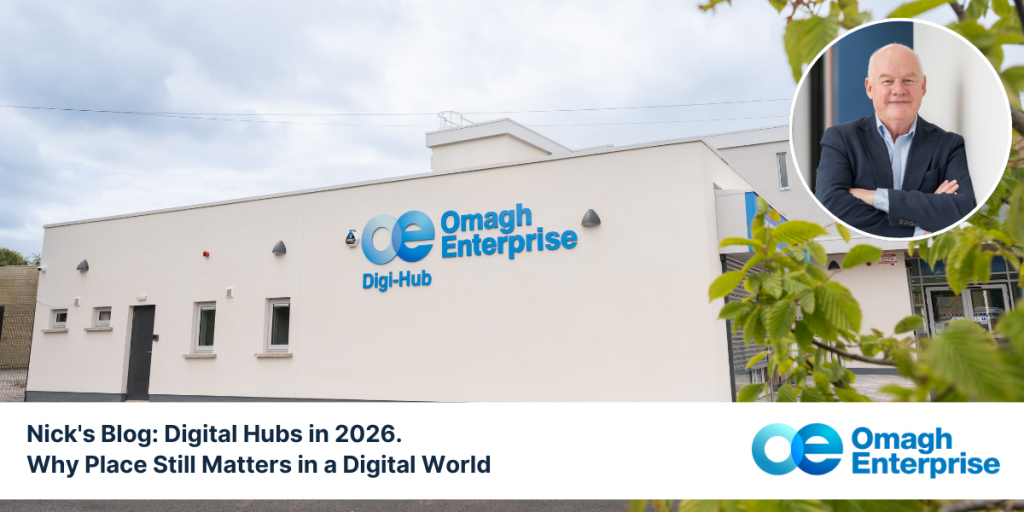
For more than a decade, we were told that place no longer mattered. Work would move online. Teams would disperse. Geography would lose its grip. The future, we were assured, was fully digital.
Some of that happened. But the conclusion drawn from it was wrong.
Work can happen anywhere. But good work rarely does. Creativity and judgement both depend on exchange and challenge. Decisions improve when people test ideas together rather than refine them in isolation.
That is why place matters more in 2026, not less: because digital progress still needs somewhere to settle.
What a digital hub actually is
Digital hubs are often described in terms of infrastructure: broadband, meeting rooms, co-working space and shared facilities. These are necessary. But they are not enough.
At their best, digital hubs function as working ecosystems. They bring together people who would not otherwise meet and give them repeated reasons to talk. Regular encounters turn shared ideas into success.
A digital hub is not just a place where people work near one another. It is a place where ideas are tested early, assumptions are discussed and decisions are shaped in full view of others who understand the work.
That is social capital in use, not in theory.
The hidden cost of digital isolation
Remote and hybrid work solve real problems. They reduce travel. They widen access. They give people greater control over how their time is used.
They also introduce unseen costs. When people work alone for long periods, ideas circulate less freely. Informal challenge fades. Learning slows. Decisions take longer because they are not discussed or resolved.
Digital hubs counter this by design. They make interaction normal rather than optional. They encourage people to understand how others work, not just what they deliver. They reinforce the advantages of working with and learning from others.
Why ecosystems outperform standalone effort
Across regions that perform well digitally, similar patterns appear. Strong outcomes do not always come from isolated start-ups, individual freelancers or single flagship projects. They often come from connected systems.
In successful hubs, early-stage founders learn from established firms. Freelancers collaborate when work exceeds individual capacity. Students move quickly from learning to building. Small organisations gain access to skills they could never justify employing alone.
This is how digital hubs turn activity into outcomes: businesses formed, jobs created, firms grown, skills retained locally. No single success explains the value. The value lies in the density of interactions sustained over time.
What this series will examine
This piece forms a monthly series on how digital hubs work in practice. It examines why hubs are becoming anchors for hybrid work, how they support start-ups and small business growth, which skills matter most in a digital economy and how AI is adopted responsibly across different organisational settings.
Each piece will focus on one idea. One problem. One clear conclusion.
Together these pieces from a field guide to how digital progress takes hold in practice.
A starting judgement
If there is one idea to take from this piece, it is this: technology scales best where people are well connected. Digital hubs make that connection deliberate rather than accidental.